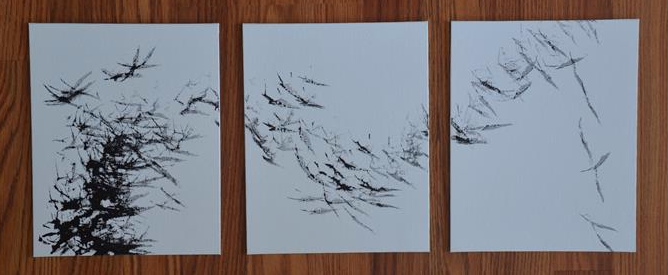
The Birds

I am roughly shaken awake. A Brother, face pale in my dark room. “It is time, we have to do it now! They are already at the door.”

I sprint down the stone steps, my coarse, heavy robes impeding my flight. I dash from the living quarters into the bustling courtyard. The sun is starting to come up, but it is still dim. Torches are lit, men in dark robes whisper urgently. The space is humming with activity, yet the only sounds are the whisper of flames and soft patter of feet.

We mustn’t wake them.

The monks are assembled, we quickly move to the livestock barn across the yard. This hour, between night and day, they are most vulnerable.

We must destroy them all.

The quietest, bravest monks have already freed what few animals are still alive, but a goat cries shrilly, and it has begun.

The air is suddenly alive with shouts and grunts, flames engulf one corner of the barn, then another. The hay doused in oil is quick to light, and the air burns, thick with acrid smoke.

Startled hisses and shrieks from the barn, high in the barn, the rafters. They wake.

The barn is not burning as fast as we had hoped, and they will take advantage.

We circle the barn, chewing garlic, holding our rosaries aloft. Prayers join the screams of rage and pain.

We mustn’t let them escape.

Soon they bolt from the building strong and swift, blurs of tattered rags, claws, fangs and terror.

We must hold the circle.

The smoke is so thick it is hard to see, I hear the cries of monks, in pain, in prayer. I hear my Brothers fighting, dying.

The circle is broken, the fire was not fast enough, and now chaos reigns. I see a Brother bleeding on the ground, eyes vacant. I see the charred remains of a beast, smoldering still.

Running, screaming, cries for help. Smoke is all I see.

Then I wake up.

Hive

Sometimes, when it was really quiet, she could hear a soft buzzing in her head.

It wasn’t always in the same spot; usually at the base of her skull, sometimes closer to the front, near her nose.

“Sinus pressure.” She dismissed her worries. “It is allergy season, after all.”

But the humming was getting louder. She could feel a vibration in her skull. She was beginning to get worried, jumpy. When her hair touched her face or her neck, it felt like the many legs of an insect, insidiously creeping over her skin.

The twitchy feelings were maddening, and the thrumming was getting stronger, more insistent.

She decided to get a haircut. A short one. She walked into the first place she saw, an old-fashioned barber shop with a striped pole in front.

“We don’t do women’s cuts.” The barber informed her.

“Buzz it.” She demanded.

The sound of the shaver was a roaring hum, the vibration over her scalp felt glorious. It drowned out the sizzling drone inside her head.

As he unclipped her smock, the humming returned.

The barber handed her a mirror, and asked, “That is quite the scar you’ve got there. Where’d you come by that?”

“On my head? I don’t have any scars on my head.”

“Sure enough you do, right above your neck.” He spun her chair so she could see for herself. He pointed, “Just there.”

An angry, purple-red mark was etched into her skin. “I don’t know where it came from…” She murmured. She reached to touch it, and it pulsed against her fingers. She felt it hum and throb.

The buzzing in her head resumed at full force, even louder than before. And now it hurt.

“Are you alright?” Asked the barber, folding the smock. “I would get that checked out.”

“I-I’m fine. Just a headache. I must have whacked my head on something… thanks.”

The pain was getting worse, she could feel it creeping behind her eyes. She hurried home, trying to ignore the thrum of activity in her head. It was in her neck, too. She could feel the vibrations shudder through her shoulders.

Her fingertips felt numb, as if she had been shocked. She collapsed on the couch, breathing heavily. Her skin was crawling, the buzzing had become a roar.

I should go to the hospital. She thought before losing consciousness.

*****

When she woke up, it was dark. It was silent. She sat up slowly, and gingerly touched the back of her neck; the wound was still there. It hadn’t been a dream.

She stood up and stepped on something with a sickening crunch. She choked back a scream and stood still. The buzzing started again, but this time it was not in her head. It was in the room. A hissing, throbbing hum that made her hair stand on end. There was no mistaking it.

The buzzing in her head was the same noise that filled the room.

She carefully reached out and turned on the light.

Not My Circus, Not My Monkeys

Every Tuesday at sunset, the clockwork monkeys gathered on the street outside my window. Clicking and chattering. Gears grinding and wheels whirling. Red glass eyes winking, copper tails twitching and sparking on the cobblestones.

I was getting damn tired of these monkeys.

The first time they appeared, the monkeys stayed on the street. Passersby stopped to laugh and point at the creatures, waiting for some sort of show to begin. But there was no magician or tinker to entertain. Just the flash of scarlet eyes as the last rays of daylight splashed across the alley. As the sun went down, the clatter of tiny metal paws and empty stares were more ominous than humorous, and the bystanders quickly departed.

The clockwork monkeys turned to face my window, one by one. They waited.

As the first stars started to twinkle in the sky, the monkeys began to disperse. Gone as quickly as they had appeared, they skittered into the night with soft clicks and clacks.

I shook it off as some sort of practical joke gone awry.

The following Tuesday, as the sun went down, they were back. This time no passersby paused to point. Eyes averted, vendors went about closing up shop, their patrons hastily withdrawing as soon as the first monkey made an appearance. Even the always crowded café across the way was empty. A few monkeys rattled amongst the tables, others crowded in front.

There were more this time. I lost count at twenty, as they continued to click-clack and tick-tock into the usually bustling alley. The only noise was the chatter and clatter of the clockworks twisting movements. The monkeys turned to stare, one by one, tails a-twitch-twitch. Then stillness.

Week after week, the mechanical monkeys stared into my window, each week edging a little closer.
As the weeks went by, I noticed something even more worrisome than the ever-encroaching metal creatures.

I saw my neighbors were no longer watching the monkeys. They were watching me.

My street had never been so quiet.

So I did the only thing I could.

I shut the blinds.

Old-Child

Old-Child

This dream is from years ago, but it still feels like it happened yesterday.

I can feel the crunch of the snow beneath my feet, hear the creak of the old metal swing set, feel the rush of the wind as I soared over the dark trees below. You know how some dreams start in the middle?

I was outside of my elementary school, in front, where the buses usually parked. It was dark, but the street lamps blazed so bright it was almost blinding. I shielded my eyes with a damp mitten, and could see the stars twinkle coldly above. I was a child, but I was old. So very old.

I crunched across the snowy lot, to the playground. The only sound was my footsteps, and the whistling wind. I was alone, but I sensed the presence of many around me, shadows of others, souls, invisible to the naked eye. They were still.

Then I saw the geese, spread out in the open field. One was apart from the others, and I approached slowly.

“Brother Goose, please give me a feather, so I may fly as you do.” I bowed respectfully. The goose stood tall, proud, his soft grey-brown feathers ruffling in the wind. He dipped his head, and plucked a feather from his wing. He extended his neck, and I took the feather. I was aloft.

The sun was coming. I could see the outlines of the hills below dark with trees, white with snow beneath. The farther I flew, the lighter it got, winter was turning to fall.

The dream shifted, and I was in the woods, an adult. It was autumn; the crunch beneath my feet was from brown leaves, not glistening snow. I knew this place.

There were a few huts made of branches, platforms in each. I stepped into the largest structure, and the three beirs in front of me were covered in leaves and dust. An ancient resting site.

Two were occupied with the bones of my siblings. The center stood empty.

I took my place.

The Orchard

I am walking through the apple orchard with my mother and my brother. The sun is shining brightly, shadows dappling the dry ground. The colors are brilliant, the bees are buzzing and the soft breeze is scented with fresh hay.

I am afraid.

We are walking fast, and I know he is going to find us, the red faced man with the too-yellow hair. I can picture the barn at the top of the hill, the sharp tools lining the walls, the chains hanging from the rafters. We can’t hide in that barn. He wants us in that barn. Red paint peeling, iron rusting, dirt floor heavy with death.

I can sense him high in the trees, slithering like a snake. Scenting the air, he knows where we are. He is watching, waiting. I know he is there.

I can’t stop walking forward, up that hill. There is nowhere else to go. My mother grips my hand tightly, without looking at me. My brother’s eyes never leave the ground.

We can’t outrun him. We can’t hide.

We are destined to end up in that barn, and there is nothing I can do.

Ascension

I am a child, and it is recess.

My backpack is heavy as I walk to the swingset.

With each step, I can feel the weight of my backpack push me forward.

If I trot, it pushes me farther, and my feet lift slightly off of the ground.

I begin to circle the swing set, the soft gravel shifting beneath my feet.

I am running, and then my feet leave the ground.

I am circling the swings, the momentum of my backpack keeping me aloft.

Soon recess is over, and I am still orbiting the playground.

Drifting higher, out of reach.

The children are filing inside the building; no one notices my absence.

I slowly float away.